Showing posts with label education. Show all posts

Wednesday, March 19, 2014

Make Just One Change

I came across this book, and was rather intrigued by the reviews on it that I decided to splurge and get it for myself.  I believe in having students write their own questions, usually for Socratic Seminar, but have never actually created a system that deepens their questioning.  The QTF promised to do that.


As with the previous blog, I have had my mind on education, literacy, and the various political shenanigans going on that affect my students and yes, me and my teacher friends as well.  So I decided to apply the Question Formulation Technique (QFT) process to something on my mind.  Lately, there has been talk about public education as a civil right, and there have been reminders floating around that we need public education for the greater good of our democracy.  I already believe this, but somehow not everyone does. 

So, applying the QFT from the book, I came up with what is called "the QFocus."  This is a statement -- simple in nature, pretty much like a debate topic -- that students can use to generate questions.

Keep in mind, it was just me doing this exercise.  I can already tell that with others the power of this exercise would be even more evident than I found it to be.  And yes, I found it deepening my thinking on something I feel I have already thought quite a bit about.

Imagine that.

Anyway, the first step is the QFocus.  Here is mine:  Public education sustains democracy.

Now, the questions.  There are rules for this, which are good for guiding students.  Since it was just me, I didn't have to follow any rules except to write down every question the way it came into my mind.  Here are my questions in the order I wrote them:

How did economics become the focus?

Why does the general public not know the real reason behind public ed?

What does it mean to "sustain democracy"?

If charters get public money, aren't they sustaining democracy?

If private schools get voucher money, aren't they sustaining democracy?

How does standardized testing fit into sustaining democracy?

Do we have a democracy to sustain?

What evidence is there that democracy is already a lost cause?

Does comparing the U.S. scores to other countries serve democracy?

Does the Billionaire Boys Club -- those who've invested millions into education -- do it for democratic purposes?

Is public ed in its present form sustaining democracy?

(I sincerely hope that as you read these questions, you thought of some of your own.  Would love to hear them.)

Anyway, the next step for students is to decide which questions are open-ended and which are closed.  I decided my first few questions are closed, but after that they are pretty open-ended and can have many different interpretations.

Following the open/close exercise, the reason for questioning is brought to the forefront.  Is it for a research paper, a project, a debate, introduction to a new unit, conclusion of a unit?   Choices are available for this section to help prioritize, and so I put myself through those as well.

#1  Pick the three questions most important to you 
What does it mean to "sustain democracy"?
How does standardized testing fit into sustaining democracy?
Is public ed in its present form sustaining democracy?

#2  Pick the three questions you want or need to answer first.
How does standardized testing fit into sustaining democracy?
Do we have a democracy to sustain?
Does comparing the U.S. scores to other countries serve democracy? 

#3 Choose the three questions that most interest you.

How does standardized testing fit into sustaining democracy?
Does comparing the U.S. scores to other countries serve democracy? 
Is public ed in its present form sustaining democracy? 


As I concluded this process I could see with a lot more clarity where I need to investigate further.  I found these questions compelling -- and I probably would never have delved into this if not for the QFT process.  I can only imagine how, when working in collaboration with others, the extremel power here.

There is a reflection section that teachers lead students through at the end of the technique, so they can determine what they have learned.  I wrote down that this opened my eyes to see that I could learn a lot more about the public education -- democracy connection. This matters to me because it is my chosen profession, and what I will be doing the rest of my life.  I feel I need to get it right.  QFT set me thinking in a more solid direction. 

Of course, this question crossed my mind:  how does this fit into the teacher evaluation?  Will an administrator understand this is a way to create deeper questioning, without the teacher having to come up with every single probing question?  I have no idea what the answer is.  I just find comfort in this quote from Albert Einstein: "The important thing is not to stop questioning. Curiosity has its own reason for existing."  I think if I can produce a few more people in our democracy who understand the power of the right questions and who have a revitalized curiosity, then I have done my job. 

???????????????????????????????????????????????????????????????????????????????????????


All We Gotta Do Is...

This week a lot of things have blown up in public education.  In our illustrious state of Florida, our commissioner announced they have hired a company to produce tests for next year.  The big deal with this is that it didn't take long for everyone to figure out that this company is highly connected to several other aspects of what is happening in education; the most high profile piece is that they are the company that created VAM -- the unstable and unreliable scoring system for teachers.

In addition, the Florida Legislature is moving toward an even larger voucher program -- never mind it was declared unconstitutional not long ago -- and up to a billion dollars in taxes may go to that, if the legislation passes through.

And we got word that a certain prominent educator in our county thinks the TEACHERS are the ones creating the pressure to teach to these tests.

Okay now.

I maintain a positive direction and focus on my own classroom.  I have been reading quite a bit this break about literacy in the United States today -- fascinating.  It has made think of my own literacy journey and how different it is for the kids today.  My students.  Our future.  The ones we are over-testing and under-educating because of it.

To lighten this blog message, check out this "protest" song by Hugh Laurie.  Although there seems to be a lot of things happening, and many people offering solutions, I am not always sure the answer is clear. 

 Click here if video isn't present.


Wednesday, October 16, 2013

What I Learned About Teaching from My College Professors

At age 42 I realized that I wanted to be a teacher.

Spent a lot of time by this lake on Edison campus after classes
At age 43, in January 1999, I began taking classes at Cuyahoga Community College: Psychology and Comp I.  I took 27 credit hours at Tri-C before moving to Florida and finishing an Associates Degree at Edison Community College in 2002.

Knowing that I wanted to be a teacher, I was highly aware of what my college professors were doing right, and I documented that in September 2001.  Some of the items made the list because a prof was doing the opposite! I like to revisit this list often because there are great reminders here of what works in education, and there are always things I find I can be doing better.

(Side note: this list is just from my first couple of years in college.  Suffice to say, many of my later college professors used the same techniques that helped me learn.) 

Here is the list:

Honor diverse styles of learning
Always choose encouraging words
Don't pander to the lowest common denominator
Collect ideas from every direction
Visuals are vital
Let students discuss openly -- encourage differing opinions
Make review and learning fun
Expect class to be disciplined in study habits
Break learning down incrementally
Be a great storyteller


Saturday, July 27, 2013

Always Write a Love Poem

I have reached the point I feared I would not reach.

I am getting excited for the new school year.

On Thursday I discovered this quote from Vincent Van Gogh: "I am in it with all my heart."

At the time, I was resisting the start of another school year.  This summer has been my best since I began teaching.  I have traveled and I have started writing again.  I participated in the best National Writing Project ever.  I'm reading whatever I want to read.  I'm having FUN!

Yet, a part of me related to Van Gogh, because I know I love teaching -- I mean, deeply love teaching. So I decided to let the quote rest inside of me while I made plans for school, alternating with still having fun and reading what I want.

It's working.

Yesterday I worked a little more in my new classroom.  I had to tear down a lot of "stuff" that didn't represent who I am as a teacher.  We teach who we are, after all.  I arranged the tables.  I made decisions.  Then I went out for sushi and a movie with my sister.

Evening came and I decided to peruse the literature collections for my 7th and 8th grade classes.  That was all it took.  I had been slightly worried for a time that I would miss teaching the higher level courses and American literature canon I have been teaching the last few years.

"Irises" Vincent Van Gogh
But I didn't need to worry.  What I see in the textbooks is everything I love.  Terrific poetry.  Wonderful stories by favorite authors: Soto, Paulsen, Cisneros, Bradbury, Giovanni, Hughes, Angelou, and yes, even Twain.  Famous speeches. Lots and lots of folktales and myths and legends. Realistic fiction. Cartoons and paintings.  And that's just the tip of it.

I am in it with all my heart. 

My mind went racing.  I pulled out the "dream" notebook I bought when I first decided to make the change from high school back to middle.  I wrote several pages of ideas for both grade levels -- mostly things I have taught at middle and high, projects that I think could be awesome, and lots of mentor text ideas.

Of course, I know the reality.  I will barely be able to scratch the surface of these ideas.  There will be more to teach than what made the list.  That doesn't matter.  What matters is that I sincerely feel ready, and a week ago I wasn't sure I was going to find that feeling.

In the 7th grade literature book, there is a selection called "a poem (for langston hughes)" by Nikki Giovanni.  In her poem she quotes Hughes:  "Always write a love poem no matter what you're doing. Always write a love poem."

I am beginning to write my love poem to this new school year.


Friday, July 12, 2013

Alabama Frame of Mind

We sailed into Alabama yesterday late morning, listening to alternative country mix on my iPod and feeling pretty good.  We had a good night's rest in Tallahassee, and Shelby Lynn was singing about "Alabama frame of mind"  (her song Where I'm From).  Alabama surprised me in a few ways. First, it is a lot prettier than anticipated -- rolling hills, lots of trees, large farms, cotton fields.  I expected it to be the scrub we've seen in southern Georgia, but not so much.

But as we drove along and made a stop in Montgomery for lunch, I found three reasons (and I'm sure there are more) on why I couldn't live in Alabama:

1. Paula Deen as guest speaker at the Ozark Civic Center  (they are obviously expecting a crowd.)
2. The t-shirt on a young lady in McDonalds.  It had a confederate flag on the back and it said: "If you find this offensive, you need a big ol' history lesson"  (Begs the question -- who really needs the history lesson.)
3. The big signs along the road that say "Go to church or the devil with get you" complete with a picture of the Satan himself.

One of the kitschy things the Bama's (as they like to call themselves) do is set up what are called "pioneer village" attractions with a bunch of old dilapidated houses and stores from days gone by.  One of these attractions doubled as a flea market.  None of them looked to have any actual visitors--perhaps they are only open on the weekends.  Nevertheless, we have been playing the license plate game in the car, and most of the plates we've seen in Alabama belong to the Bama's (one even says Sweet Home Alabama -- but I bet you guessed that), or Tennesseeans, who always seem to be in a great hurry to get out of Alabama. Made me wonder just who is going to these exhibits.

As we traveled toward Birmingham, the hills got steeper.  So much of that area reminded us of  West Virginia, around the Charleston area.  If I ever knew it I had forgotten that Birmingham was a steel and mining town at one time.  I was expecting a little more Atlanta, a little less Pittsburgh.

We found our destination easily enough: Kelly Ingram Park in downtown.


Ever since my first year teaching, I have taught the Birmingham Children's March which took place in May, 1963 and was directly responsible for finally getting desegregation laws passed in Alabama and the rest of the country.  Kelly Ingram Park was the meeting place for the people who participated.  This was organized after Martin Luther King had been jailed for nonviolent protests (called unlawful parades) and where he wrote his famous "Letter from Birmingham Jail."  Young people rallied to the cause, as their parents were not in positions to take such risks.


The first day of the protests, the police arrested over 1,000 young people.  The next day, when even more showed up, they turned the fire hoses on them and set the dogs loose. This sad history is commemorated in Kelly Ingram Park.

Detail of dog attack


The park itself is a large, public square (which sadly hosted more than one hanging of a black person lynched in early days) and now contains a pathway called "The Walk of Freedom" which allows a visitor to follow the philosophy, the steps taken in the movement, and is complete with sculptures depicting various events of the march.  There is also a large statue of Martin Luther King, looking toward the Sixteenth Street Baptist Church, the site that would later suffer a bombing and the loss of four young lives.

Sculpture of water hoses pointed at young marchers.

We walked around the park and I took pictures of everything, feeling now I will be able to enhance my lesson on this further.  Many of the locals were happy to act as tour guides -- okay, they were homeless black men, but they were friendly enough, telling us all about the various sculptures and, of course, just charging a small tour guide fee.  We engaged in many of these conversations and honestly, it just added to the enjoyment.

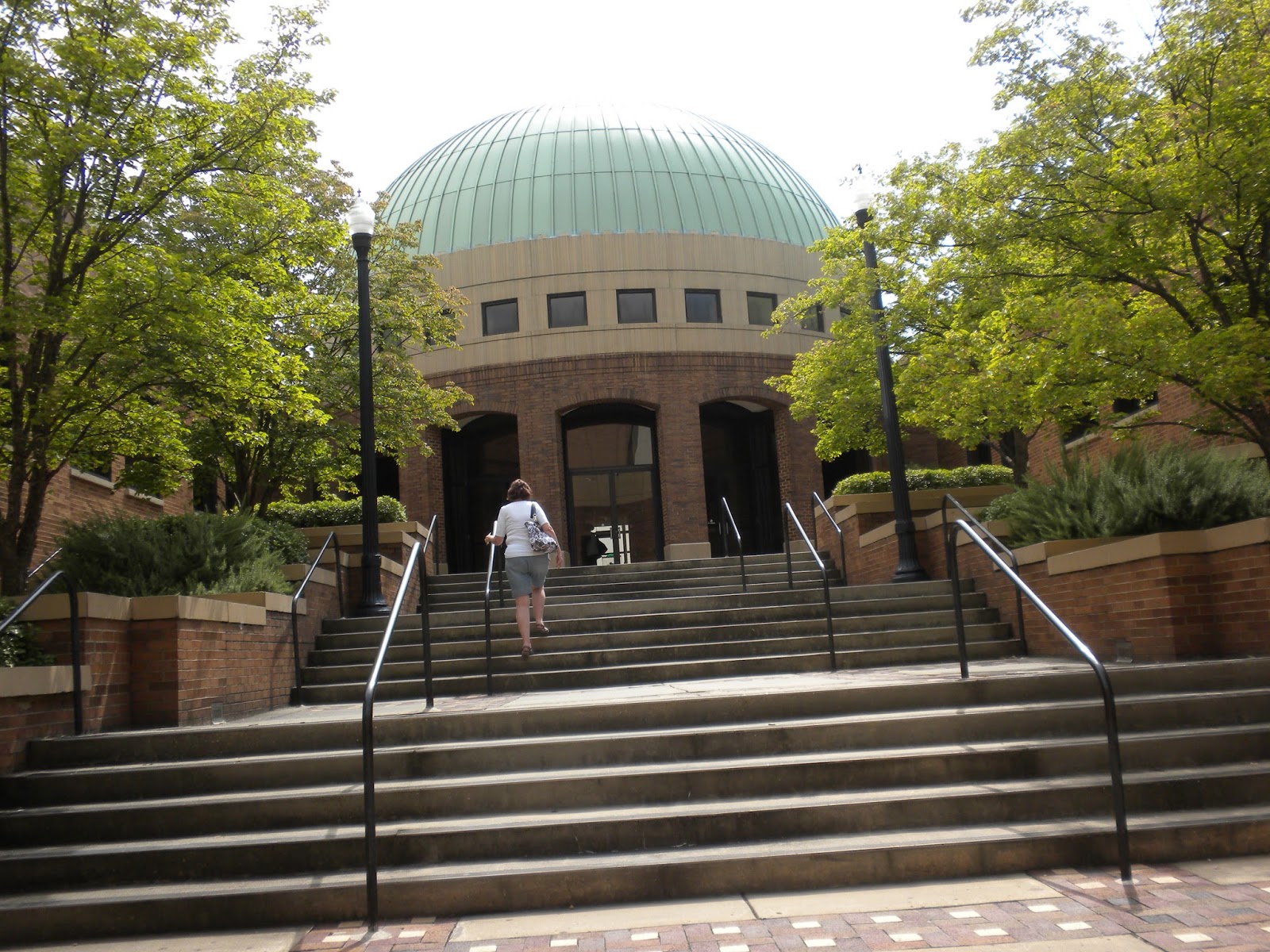
The church was already closed to tours when we got there, so we headed over to the Civil Rights Institute, an impressive collection and timeline of the Civil Rights Movement.  I have been to many exhibits and museums in my life, and I have to say this one ranks very high in my mind for its artistic displays and organization.  It is comprehensive in scope, very moving in parts, with actual video footage playing, speeches by King, and more.  It takes a cold hard look at segregation and its effects.

Sixteenth Street Baptist Church, site of bombing

So I was having a great time taking pictures of everything I found of interest in the museum, when an employee came up to us and engaged us in a conversation -- oh, you're a teacher? My sister is a teacher!  Friendly and warm, but with a message -- you're not allowed to take pictures in here, it is all copyrighted, they should have told you when you came in.  I was super bummed at that point, because I knew they had the actual jail cell King was in, and I wanted a picture of that for sure.  I did sneak one later, but it didn't come out that good, because I sincerely did not want them kicking me out of the museum. Because of that, I won't be posting any pictures of from the museum here, but I will make a slide show for my classroom.

Walking up the stairs to the Civil Rights Institute


Today we head to Nashville, traveling a scenic route to get there.  Tonight we have tickets for the Grand Ole Opry, and will be doing some additional sightseeing over the weekend connected with the huge country music tradition in Nashville.  Just relaxing and taking it all in!

Tuesday, July 2, 2013

Who Made You King of Anything?

Thank you for your time
Don't waste any more of mine.

National Education Association's president Dennis Van Roekel needs to take a good look at this photo from July 5, 1935.

Many fought for union rights, including collective bargaining

More information about photo here

As a member of the union, I am disheartened to hear that the NEA is turning away from assisting us at state levels with issues like collective bargaining, and instead turning full focus toward implementation of Common Core.

You've got the talking down but not the listening

I thought that was part of being in the union -- having someone to stand up for us.  I'm all for teachers and the union being on the same page, to have a united front and common message, but I think collective bargaining needs to be part of that message.

Just because battles were lost in Wisconsin and Michigan does not mean we have to throw in the towel.  In fact, all the more reason to continue the good fight.  It is for the better education of children, after all, which benefits everyone.  The larger class sizes and continued reduction of time and money available for good teaching will erode our education system to the point of no return.

I am fortunate to teach English Language Arts, which cannot be separated from culture and history.  I have taught Martin Luther King's "Letter from a Birmingham Jail" many times. He was addressing the ministers who were telling him to quit, that now wasn't the time for this fight.  He responded quite eloquently, and included a quote from St. Augustine: "An unjust law is no law at all."

What if he had listened to them and quit, just because the going got tough?

Where is our King?  Unfortunately, I do not see anyone of that caliber heading up the national unions, right when we need them most.

Unfortunately, many of the "deformers" out there do think they are kings (and a few queens) of education.  They like to tell us what is good for us.

The message from NEA is supposed to make us feel good -- teachers taking control of Common Core.

Yay?

I dedicate this to all the "deformers" of education:
King of Anything


Thursday, June 27, 2013

The Night Chicago Died

 I heard my mama cry  
I heard her pray the night Chicago died  
Brother what a night it really was  
Brother what a fight it really was, glory be
(Callander and Murray, 1974)

This video posted below made me cry.

The situation in Chicago and so many other places is reaching a critical juncture.

But that is not what makes me cry.

It is that these students have to fight so hard for what is their right in this country.


Watch the video, and see how this unfolded.

Be very worried about how public speech is being shut down, along with public schools.

Chicago Public School Board Meeting


Sunday, June 23, 2013

Don't Read This Blog

Last fall, I attended the Sanibel Island Writer's Conference and spent two mornings in writing workshops with Steve Almond.  Today I encourage you to read an important essay he has in today's New York Times.

The title of the essay is "My Kids are Obsessed With Technology, and It's All My Fault."  It raises good questions about what seems to be the avalanche heading toward us -- every kid having his or her own iPad in school. 

We had a similar debate at National Writing Project this week -- the pros and cons of this issue. Almond raises some very good questions, and I'm raising up some questions myself. Because, honestly, I don't know how I feel about this.

Almond told us "Tell the truth about what matters to you."  I would love to hear from educators and parents regarding this issue, either as comments here or on Facebook or email.

Here is Almond's essay

MY QUESTIONS:

1. Will iPads become just another way for the textbook companies to figure out how to soak the educational system of every bit of funding it has?

2. Will iPads become a way to monitor teachers?  Increase class sizes?  Standardize education?

3. Will the availability of iPads become another way to see the divide between the "haves" and the have-nots"?

4. How will educators ever formulate a clear and effective plan for the use of these devices?

5. How will educators create a common vision on the use of these devices?

[Note that in the last two questions I put educators as the ones who will make these decisions.  However, my real fear is that people outside of education will make these decisions. That leads to my next question.]

6. Will educators be allowed to make decisions on iPad use, or will it just be another dictate from above?

7.  Is this another way to script the role of the teacher by creating a system whereby knowledge of how to engage children in deep learning is no longer needed?

8.  Dewey said that all experiences live on in future experiences.  What kind of world does the above scenario set up?  What kind of expectation of the future?

9.  I suppose it always comes back to this:  what is the best way to be educated?  How do we strike a balance with advancing technology and the need to slow down and pay attention to something that isn't moving at a lightning pace?

And as I write that last question, I think of Almond's cardinal analogy, and think...mmm...even cardinals move at a lightning pace -- the gorgeous flash of red we see out of the corner of our eye.

But they also stop at times to take in the world around them, tend carefully to their nests, follow the cycles of nature, and yes, sing their proud song Birdy Birdy Birdy.

The natural world has much to teach us if we will, as Almond suggests, slow down and pay attention.  I hope we can take a collective breath before rushing headlong into something that will end up being just another way to avoid the complexities of what it means to be truly educated.


Friday, June 7, 2013

Cynical Girl

Well I'm goin' out
I'm goin' out lookin' for a cynical girl
Who's got no use for the real world
I'm lookin' for a cynical girl

(Marshall Crenshaw)

FCAT scores come out today.

Yippee.

Despite the fact that every educator knows what flaming nonsense this all is, we will look at the scores and either feel relieved or depressed, we will consider the consequences, either monetarily or professionally, and we will call it a day.

Yes, I'm feeling cynical this morning.

Yesterday I watched President Obama's education speech.  No, I wasn't expecting much.  His record on education has been less than stellar in my opinion.  Race to the Top is an utter disaster, Duncan hasn't a clue, and the silence on the Chicago school closings is deafening.  I had heard the speech was about promoting technology and digital learning, so I was definitely wary going in.

His proposal?  To expand bandwidth in every school in the country (then somehow it got reduced to 99% of the schools; not sure what constitutes the 1% who don't rate) within the next five years. This is to give technology a boost, enabling private innovators to create products for digital learning, and for students to each have their own laptop or tablet. 

Shazam.

What I heard?  We're going to make sure you have the bandwidth so that when we have to test every K-11 grader in 2015, we can actually do it.  That if each kid has their own laptop, there is no excuse.  This is to fix the Common Core testing issue which has been looming in the background, and allow for more private companies to profit off public schools.  It is to make the "wave of the future" digital learning a reality.  Oh yeah, and compete with other countries. Always competition.

Depressing.

Okay, so back to FCAT scores.  Where I sit right now, I am uncertain if these scores have anything to do with me.  You see, no one this year told me how I'm being evaluated on the 50% of my evaluation that is to be based on student test scores.  I know I was told that the test my 11th graders took would not be used because of the testing issues (bandwidth!), but all I know is that they said they wouldn't use the scores.  What will they use instead?  So I'm left rooting for decent FCAT reading scores just in case this year, like last year, I'm rated on kids I don't teach.

There is, though, a tiny glimmer of hope.  This week an organization called FairTest put out a listing of all the media reports against standardized testing.  It was quite a list.  There is a growing movement against standardized tests and Common Core implementation, which is certainly good news. Every educator knows that his or her voice is totally ignored -- that only parental involvement in the issue will actually turn it around. The movement against is getting strong enough that the corporate reformers are getting more vocal about their real intentions all along (google Jeb Bush and get an earful on that!)  They will not go down without a fight.

It's a civil war, folks.

Yet even with all that, with everything we know, we will still be tempted to look at the scores as a way to measure something about us, about our schools, about our community.  We will feel justified in our teaching methods or question ourselves to the nth degree about "what happened."  We are caught up in this crazy, insane, dysfunctional, toxic, and ridiculous system, even as we hope, pray, and fight for a way out of it.

But we're getting more bandwidth.

Yippee.